Hyperbaric Oxygen Therapy for Avascular Necrosis (AVN)

Key Takeaways
- Avascular necrosis (AVN) occurs when reduced blood supply causes bone tissue damage, most commonly affecting the femoral head of the hip.
- Early diagnosis is important because joint-preserving treatments are most effective before bone collapse occurs.
- Hyperbaric oxygen therapy (HBOT) has been studied as an adjunctive treatment that may reduce bone marrow oedema, improve oxygen delivery, and support bone repair.
- Clinical evidence suggests HBOT may improve pain, function, and imaging outcomes in selected patients with early-stage AVN.
- Once structural collapse develops, surgical treatment such as total hip replacement is often required.
Quick Summary
Avascular necrosis, also called osteonecrosis, develops when blood flow to bone tissue is reduced or interrupted. The femoral head of the hip is the site most commonly affected.
Early diagnosis is important because treatments aimed at preserving the joint are most effective before structural collapse occurs.
Hyperbaric oxygen therapy (HBOT) has been studied as a treatment that may improve oxygen delivery to ischemic bone, reduce bone marrow oedema, support vascular repair, and improve pain and functional outcomes in selected early-stage patients.
The strongest evidence for HBOT exists in Stage I and Stage II AVN, before collapse of the femoral head.
Care Strategy
Early-Stage AVN (Stage I-II)
Primary goal: preserve the joint and improve bone viability.
Possible treatment approaches include:
- Hyperbaric oxygen therapy
- Core decompression
- Biological therapies such as bone marrow aspirate concentrate (BMAC)
- Pharmacologic management and monitoring
Typical HBOT protocols reported in studies include:
- 30–40 treatment sessions
- 5 sessions per week
- 90 minutes per session
- 2.0–2.5 ATA pressure
Combination Therapy
Some research suggests HBOT combined with core decompression or regenerative therapies may produce improved outcomes compared with individual treatments alone.
Advanced AVN (Stage III-IV)
If structural collapse and degenerative arthritis develop, joint-preserving treatments are usually less effective and total hip arthroplasty (joint replacement) often becomes the primary treatment pathway.
Detailed Overview of Avascular Necrosis
Avascular necrosis (AVN), also known as osteonecrosis, is a condition in which bone tissue begins to die because its blood supply has been reduced or interrupted. The femoral head of the hip is the most commonly affected site, although AVN can also occur in the knee, shoulder, ankle, and other joints. As the condition progresses, the weakened bone may collapse, which can lead to joint surface damage, pain, loss of mobility, and secondary arthritis. According to the American Academy of Orthopaedic Surgeons, osteonecrosis most commonly affects the hip and can ultimately destroy the joint if blood flow is not restored 1. Advanced disease often requires joint replacement surgery.
Early diagnosis is especially important because treatment outcomes are generally better before structural collapse occurs. Magnetic resonance imaging (MRI) is the most sensitive tool for detecting AVN in its earlier stages, often before changes are visible on plain X-rays 2. This makes early-stage recognition central to joint-preserving treatment strategies.
Among the conservative and joint-preserving approaches investigated for avascular necrosis is hyperbaric oxygen therapy (HBOT). Over the past two decades, a growing body of clinical research has evaluated whether HBOT may reduce pain, improve function, decrease bone marrow oedema, and help slow disease progression in selected patients with early-stage femoral head osteonecrosis 3 4.
Aetiology, Staging, and Treatment Pathway of Avascular Necrosis
Avascular necrosis develops when circulation to bone is impaired. Causes may include trauma, hip dislocation or fracture, long-term corticosteroid exposure, excessive alcohol intake, clotting disorders, autoimmune disease, and certain metabolic or hematologic conditions. In some patients, no clear cause is identified, and the disease is considered idiopathic. The American Academy of Orthopaedic Surgeons (AAOS) also notes that osteonecrosis can follow injury or arise in association with other medical conditions and risk factors 1.
Clinically, AVN of the femoral head is commonly described using the Ficat staging system, which tracks progression from early ischemic injury to collapse and arthritis 2. The stages are typically described as follows:
- Stage I: Standard radiographs may appear normal, but MRI can detect early bone marrow changes and ischaemia.
- Stage II: Early structural abnormalities become visible on imaging, although the joint surface has not yet collapsed.
- Stage III: A subchondral fracture develops, often referred to as the “crescent sign”, with early flattening or deformation of the femoral head.
- Stage IV: Advanced joint degeneration occurs, including collapse of the femoral head and secondary osteoarthritis.
This stage-based framework matters because treatment decisions are strongly linked to whether the femoral head has already collapsed 2.
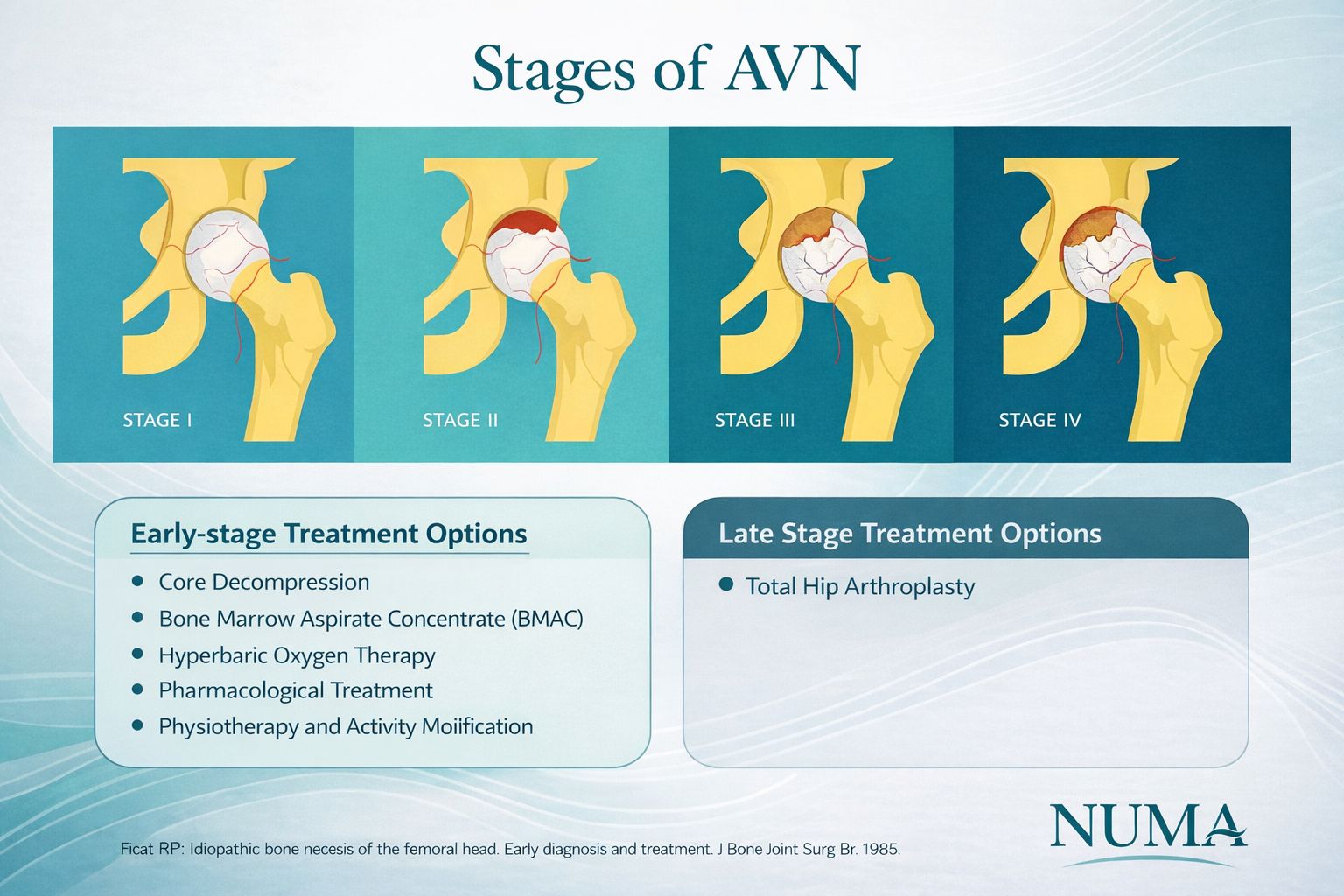
Treatment strategies are closely tied to disease stage. In early-stage AVN, before structural collapse of the femoral head occurs, the primary goal is to preserve the joint and restore bone viability. Joint-preserving strategies include core decompression, biological therapies like bone marrow aspirate concentrate (BMAC), pharmacologic management, and hyperbaric oxygen therapy (HBOT) 3 4.
Clinical studies over the past two decades have shown that HBOT can improve oxygen delivery to ischemic bone, reduce bone marrow oedema, relieve pain, and improve functional outcomes in patients with early-stage osteonecrosis 3 4. Clinical research has also demonstrated that hyperbaric oxygen exposure can mobilise circulating stem and progenitor cells, potentially supporting vascular repair and bone regeneration in ischemic tissue 5.
Once the femoral head has collapsed and degenerative arthritis develops, joint-preserving treatments are generally less effective, and total hip arthroplasty (joint replacement) often becomes the primary treatment pathway 2.
What Is Hyperbaric Oxygen Therapy?
Hyperbaric oxygen therapy involves breathing near-pure oxygen inside a pressurised chamber, typically at pressures around 2.0 to 2.5 ATA. Under these conditions, oxygen dissolves into the blood plasma at much higher concentrations than under normal atmospheric pressure, which can improve tissue oxygen availability in areas where perfusion is reduced 5.
Because AVN is fundamentally related to impaired blood supply and ischaemic bone injury, HBOT has attracted interest as a treatment that may support bone survival and repair in pre-collapse disease 3 4.
How Hyperbaric Oxygen Therapy May Help Bone Healing in AVN
Improved Oxygen Delivery
HBOT increases tissue oxygen tension and may help oxygen reach bone areas affected by reduced circulation 5.
Reduction of Bone Marrow Oedema
Several studies have reported reductions in bone marrow oedema during or after HBOT treatment 6 7.
Angiogenesis and Bone Repair
Hyperbaric oxygen has been associated with activation of angiogenic pathways involved in vascularisation and bone regeneration 5.
Modulation of Inflammation
Clinical studies have reported reductions in inflammatory markers including TNF-α and IL-6 following HBOT 8.
Taken together, these mechanisms provide a biologically plausible basis for using HBOT as an adjunctive treatment in selected patients with early osteonecrosis, although the available clinical studies remain heterogeneous in design and outcomes 9.
Clinical Evidence for Hyperbaric Oxygen Therapy in AVN
Clinical research evaluating hyperbaric oxygen therapy for avascular necrosis spans more than two decades and includes controlled trials, observational cohorts, mechanistic studies, and comparative treatment analyses.
Early Controlled and Randomised Studies
Reis et al. (2003) reported normalisation of MRI findings in 81% of HBOT-treated patients compared with 17% in untreated controls 3.
Camporesi et al. (2010) conducted a randomised controlled trial showing improvements in pain, mobility, and hip function following 30 HBOT sessions 6.
Observational Cohort and Longer-Term Outcome Studies
Koren et al. (2015) reported high rates of radiologic improvement and long-term hip preservation in patients with Stage I–II AVN 4.
A 2024 report described a 30-year single-centre experience showing stable or improved imaging outcomes in many treated joints 10.
A prospective study by Ansari et al. reported improvements in Harris Hip Scores, pain levels, and MRI measures after HBOT 7.
Mechanistic Evidence
Bosco et al. demonstrated reductions in inflammatory markers and oxidative stress after HBOT in AVN patients 8.
Other studies have shown HBOT can mobilise circulating stem and progenitor cells, supporting vascular repair processes 8 5.
Comparative and Combination Therapy Studies
Sun et al. reported functional improvement with HBOT comparable to core decompression, while combined HBOT and core decompression showed the best outcomes at one year 11.
Emerging research has also explored HBOT combined with bone marrow–derived therapies such as BMAC to enhance regenerative responses.
Current Medical Perspective
A systematic review and meta-analysis by Paderno et al. found significantly greater clinical improvement in patients receiving HBOT 9.
However, other reviews highlight the limited number of large, randomized trials and heterogeneity in study design.
Overall, the literature suggests HBOT may represent a valuable adjunctive therapy for selected patients with early-stage AVN, particularly before structural collapse occurs.
Typical HBOT Treatment Protocol for AVN
Common protocols include:
Safety and Side Effects of HBOT
When administered in a specialised medical setting, hyperbaric oxygen therapy is generally well tolerated. Most side effects are mild and temporary, including ear or sinus pressure, transient vision changes, and fatigue, while rare complications such as middle ear barotrauma or oxygen toxicity or neurological or pulmonary effects can occur. Careful patient screening and supervision by clinicians trained in hyperbaric medicine help minimise these risks 12.
Frequently Asked Questions
Can hyperbaric oxygen therapy cure avascular necrosis?
HBOT should not be described as a guaranteed cure. Current evidence suggests it may improve pain, function, and imaging outcomes in selected patients before collapse 9.
What stage responds best?
The strongest published evidence is in Stage I and Stage II AVN, before collapse of the femoral head 3 4.
Can HBOT replace core decompression?
Not necessarily; combination treatment may offer improved outcomes 9.
How many treatments are usually used?
Typically 30–40 sessions lasting about 90 minutes 6 7.
Is HBOT safe?
Generally well tolerated with mild temporary effects 12.
References
Footnotes
- American Academy of Orthopaedic Surgeons. Osteonecrosis of the hip Internet. Rosemont (IL): American Academy of Orthopaedic Surgeons; cited 2026 Mar 15. https://orthoinfo.aaos.org/en/diseases--conditions/osteonecrosis-of-the-hip ↩ ↩2
- Petek D, Hannouche D, Suva D. Osteonecrosis of the femoral head: pathophysiology and current concepts of treatment. EFORT Open Rev. 2019;4(3):85-97. https://doi.org/10.1302/2058-5241.4.180036 ↩ ↩2 ↩3 ↩4
- Reis ND, Schwartz O, Militianu D, Ramon Y, Levin D, Norman D, et al. Hyperbaric oxygen therapy as a treatment for stage-I avascular necrosis of the femoral head. J Bone Joint Surg Br. 2003;85(3):371-375. https://pubmed.ncbi.nlm.nih.gov/12729112/ ↩ ↩2 ↩3 ↩4 ↩5 ↩6
- Koren L, Ginesin E, Melamed Y, Norman D, Levin D, Peled E. Hyperbaric oxygen therapy for femoral head osteonecrosis. Orthopedics. 2015;38(3):e200-e205. https://pubmed.ncbi.nlm.nih.gov/25760507/ ↩ ↩2 ↩3 ↩4 ↩5 ↩6
- Feng J, Zhu C, Zou J, Zhang L. Hyperbaric oxygen therapy for the treatment of bone-related diseases. Int J Mol Sci. 2025;26(3):1067. https://doi.org/10.3390/ijms26031067 ↩ ↩2 ↩3 ↩4 ↩5
- Camporesi EM, Vezzani G, Bosco G, Mangar D, Bernasek TL. Hyperbaric oxygen therapy in femoral head necrosis. J Arthroplasty. 2010;25(6 Suppl):118-123. https://doi.org/10.1016/j.arth.2010.05.005 ↩ ↩2 ↩3 ↩4
- Ansari S, Gaurav A, Gupta T, Bondarde P, Madhusudan CHRBV, Mago V, et al. Hyperbaric oxygen therapy is effective and safe for femoral head osteonecrosis: a prospective mid-term outcome study. Eur J Orthop Surg Traumatol. 2025;35:336. https://pubmed.ncbi.nlm.nih.gov/40751751/ ↩ ↩2 ↩3 ↩4
- Bosco G, Vezzani G, Mrakic-Sposta S, Malacrida B, Giustarini D, Rizzato A, et al. Hyperbaric oxygen therapy ameliorates oxidative stress and inflammation. J Enzyme Inhib Med Chem. 2018;33(1):150-155. https://pubmed.ncbi.nlm.nih.gov/30274530/ ↩ ↩2 ↩3
- Paderno E, Zanon V, Vezzani G, Giacon TA, Bernasek TL, Camporesi EM, Bosco G. Evidence-supported HBO2 therapy in femoral head necrosis: a systematic review and meta-analysis. Int J Environ Res Public Health. 2021;18(6):2888. https://doi.org/10.3390/ijerph18062888 ↩ ↩2 ↩3 ↩4
- Currie JR, Gawthrope IC, Banham ND. The use of hyperbaric oxygen for avascular necrosis of the femoral head and femoral condyle: a single centre's experience over 30 years. Diving Hyperb Med. 2024 Jun 30;54(2):92-96. https://pubmed.ncbi.nlm.nih.gov/38870950/ ↩
- Sun M, Liang H, Chen Y, Duan S, Xu R, Cai Z. A retrospective comparison of hyperbaric oxygen and core decompression for mild to moderate avascular necrosis of the femoral head. Med Gas Res. 2026;16(1):1-5. https://doi.org/10.4103/mgr.MEDGASRES-D-24-00162 ↩
- Camporesi EM. Side effects of hyperbaric oxygen therapy. Undersea Hyperb Med. 2014 May-Jun;41(3):253-7. PMID: 24984321. https://pubmed.ncbi.nlm.nih.gov/24984321/ ↩ ↩2